
Breast Reconstruction
Overview
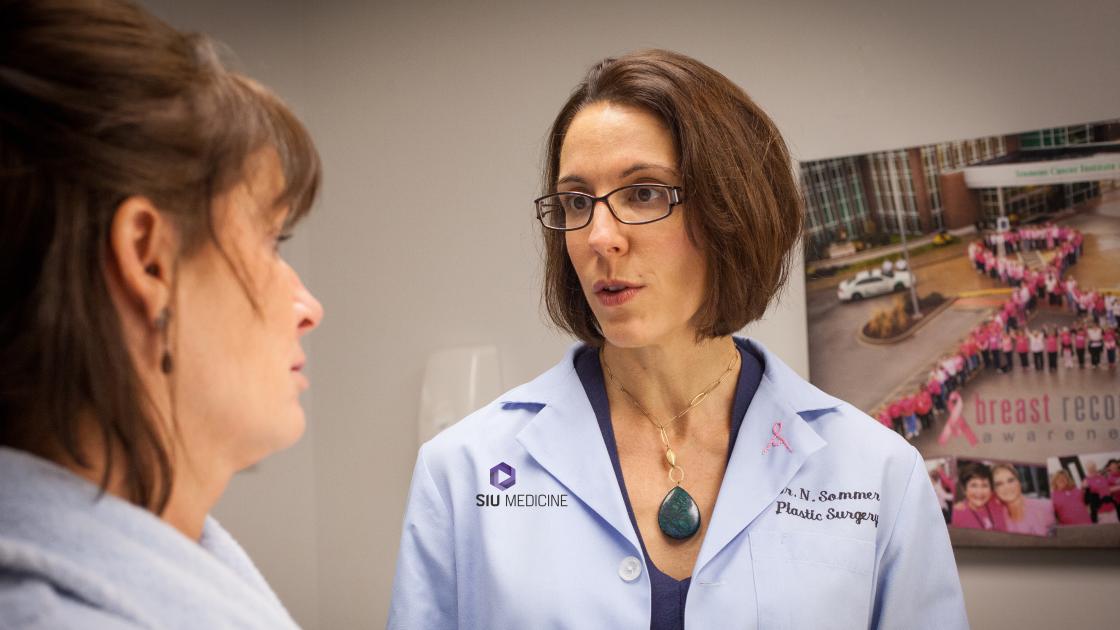
Breast reconstruction involves recreating a breast after a mastectomy with expanders, implants or using the patient's own skin/fat. Breast reconstruction also involves treating breast deformity/asymmetry.
Before you begin breast cancer treatment, consider your breast reconstruction options. Your general surgeon should discuss the option of breast reconstructive surgery with you and offer you a consultation with a plastic surgeon to discuss your options more in-depth.
Patients can choose to undergo breast reconstruction immediately, that is, at the time of mastectomy, or delayed, at a second procedure. The timing is dependent on many issues, such as whether or not there is a plastic surgeon in your community who can perform the procedure, what other treatments are needed for cancer treatment, or simply patient preference. An immediate reconstruction is an ideal option for a patient who has a nicely shaped breast. In this case, a skin-sparing mastectomy may be performed, which will preserve the natural breast skin envelope and improve the breast reconstruction outcome. Delayed reconstruction may be better for a patient who knows they will need radiation after mastectomy. You should carefully weigh your options and discuss immediate versus delayed reconstruction with your plastic surgeon.
The goal of breast reconstruction is to rebuild a breast mound, which is as symmetrical as possible to the opposite breast. Once the mound is in place, your surgeon will reconstruct the nipple and areola at a second stage along with any revisions or matching procedures, such as reduction, lift or augmentation, on the opposite breast to improve breast symmetry. Occasionally the nipple and areola reconstruction is delayed to a third stage to maximize symmetry.
Realistic expectations
The goal of breast reconstruction is to create a breast mound and a new nipple and areola. However, there are some important limitations to the reconstructed breast mound no matter what type of reconstruction you choose. Whether the reconstructed breast is made from an implant, or back, abdominal or buttock fat, the mound is flatter than a normal breast. A normal breast has a cone shape, which is primarily from the tissue just beneath the nipple and areolar complex and is difficult to completely recreate with reconstruction.
Although the reconstructed breast often feels quite natural, especially when your own tissue is used, the reconstructed breast will likely not feel like your other breast. A reconstructed breast is often denser than a normal breast and will not conform into a bra as normal breast tissue will. Nipple and areola reconstruction give the breast the look of a real nipple and areola but do not reconstruct the cone beneath them. Reconstructed breasts often do not age the same as a normal breast and therefore you may desire further symmetry procedures on the opposite breast in the future. The best outcomes are often when the same procedure is performed on both breasts, which is the case with bilateral reconstruction.
Tissue expanders
Tissue expander/implant reconstruction is a simple procedure in which the surgeon inserts a balloon-like device under the breast skin and pectoralis muscle and fills with saline over a series of office visits to slowly stretch the skin and muscle to the desired breast size. Once the tissue expansion is complete, a second procedure is performed to remove the expander and place the permanent implant, either a saline or silicone implant. This procedure is the shortest type of reconstruction with the least amount of recovery and downtime.
Reconstruction with your own tissue
Reconstruction by using your own tissue is called flap reconstruction, which is identified by where the tissue (fat and skin) comes from. The most common areas where tissue is taken are the back and abdomen. In general, flap reconstruction results in the most natural-appearing breast.
Breast reconstruction options include:
- Tissue expander/implant
- Latissimus flap - skin, fat, and muscle from your back
- TRAM flap - skin , fat, and muscle from your abdomen
- DIEP flap - skin and fat from your abdomen
- SGAP, Superior Gluteal Artery Perforator - skin and fat from your buttocks
Each procedure has pros and cons, which your plastic surgeon can explain in more detail.
Specialty care
Our providers

Treatment locations

Why SIU
Continually learning
With a focus on continual improvement, our doctors take the time to research, study and innovate to provide the latest treatments for our patients.
Patient-first experience
Our care ranges from primary care physicians to specialists and sub-specialists who have advanced training. We're here for you when you need us.
Breakthrough tech
Continually teaching the next generation of doctors, our physicians use the latest developments in procedures and technologies for our patients.
Latest articles

SIU Medicine to address breast cancer disparities at CAP 1908

SIU Medicine employee, breast cancer survivor to model at New York Fashion Week