
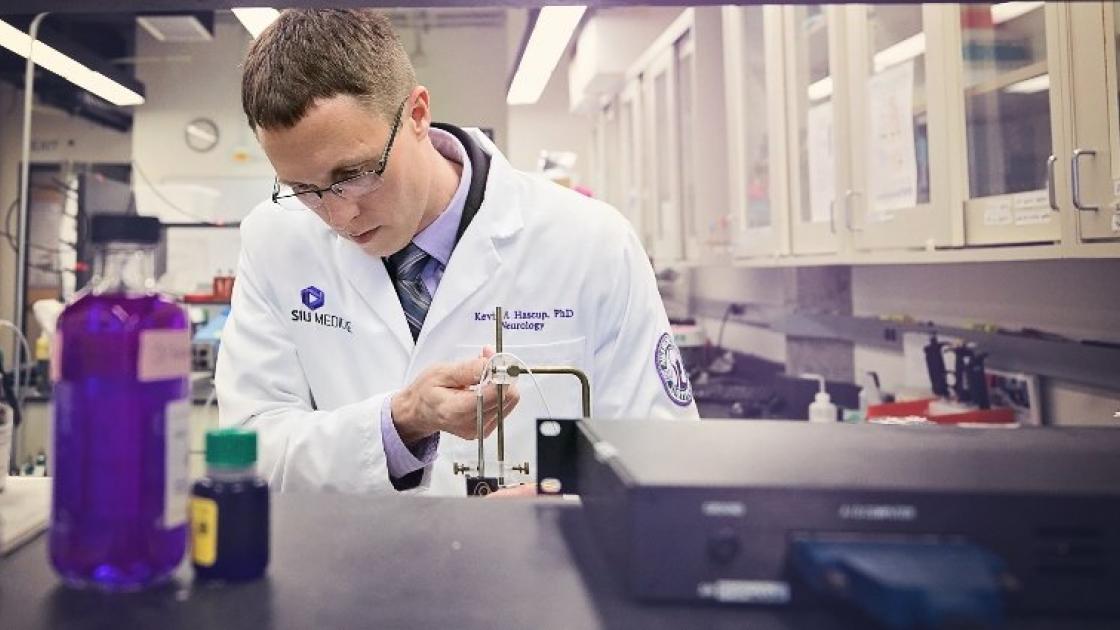
Alzheimer's research advances at SIU Medicine
Right now, an estimated 5.8 million Americans have Alzheimer's disease. As the global population continues to age, more people will be affected by this neurodegenerative disorder. Sadly, Alzheimer’s could impact up to 14 million Americans by 2050 if no cure is found.
As leaders and innovators in academic medicine, clinical care and scientific research, SIU Medicine is proud to join a global community of providers and researchers who are striving to make a difference in the lives of people affected by this condition. Thanks to a generous donation, the Dale and Deborah Smith Center for Alzheimer’s Research and Treatment at SIU has been able to ramp up critical projects, programs and services throughout the state of Illinois.
Alzheimer's disease research underway at SIU Medicine
Teams at the Center for Alzheimer’s Research and Treatment are currently seeking funding for a variety of research projects to advance understanding of Alzheimer's disease and dementia. They want to provide answers to some important theoretical and clinical questions, and empower patients through a combination of pharmacological and non-pharmacological solutions. These include:
- The connection between Alzheimer’s disease and diabetes. Why do diabetic patients have an increased risk of Alzheimer's? Can improving insulin sensitivity prevent cognitive decline?
- Targeting receptors related to Alzheimer’s disease. Alpha7 nicotinic acetylcholine receptors (α7nAChR) are found in the brain, spleen and lymph nodes. They are used in long-term memory, anti-inflammation and other systemic processes within the body. This research project explores medications to decrease activity in these receptors, potentially reducing cognitive decline and restoring the function of a neurotransmitter called glutamate that is thought to be involved with dementia.
- Post-traumatic stress disorder (PTSD) and Alzheimer’s disease. Why are military veterans with PTSD twice as likely to develop Alzheimer's disease as veterans who don't develop PTSD? What can be done to mitigate this risk?
- Neurotransmitter activity in Alzheimer’s disease progression. How do changes with the neurotransmitter glutamate influence the development and progression of Alzheimer's disease over time? Can we identify early biomarkers of Alzheimer's disease and use this information as a way to delay or alter cognitive decline?
- Cellular senescence, inflammation and neurotransmission in Alzheimer’s disease. As we age, more of our cells stop functioning properly. This process, called “senescence,” is markedly increased in Alzheimer's patients. Studies are designed to better understand how senescence correlates with inflammation, neurotransmitter activity, memory and learning.
- COVID-19 and Alzheimer’s disease. There is evidence that dementia increases the risk and severity of COVID-19, but the long-term consequences and mechanisms (the why) are not known.
- Improving healthspan in people with Alzheimer's. What can be done from a metabolic and scientific perspective to preserve cognitive function and improve overall healthspan in people with Alzheimer's?
- Refining Alzheimer’s disease demographics for improved outcomes. What types of rural/urban and racial disparities exist with Alzheimer's disease prevalence, treatment and outcomes?
Many of these studies are already underway and will be pursued over the next few years. SIU Medicine scientists welcome discussion about additional areas of research. If you are interested in donating to aid these efforts, go to forwardfunder.siumed.edu or contact:
SIU School of Medicine
Foundation Office
Attn: Alzheimer’s Research – Hascup Lab
927 N. Rutledge
PO Box 19666
Springfield, IL 62794
Support alzheimer's research—Get involved with SIU Medicine
Has someone in your life been affected by Alzheimer's disease? You can get involved and help them! Call 217-545-8000 to learn how our multidisciplinary team at SIU Medicine can provide solutions and support to improve your loved one's quality of life “Beyond the Medical Center.”